
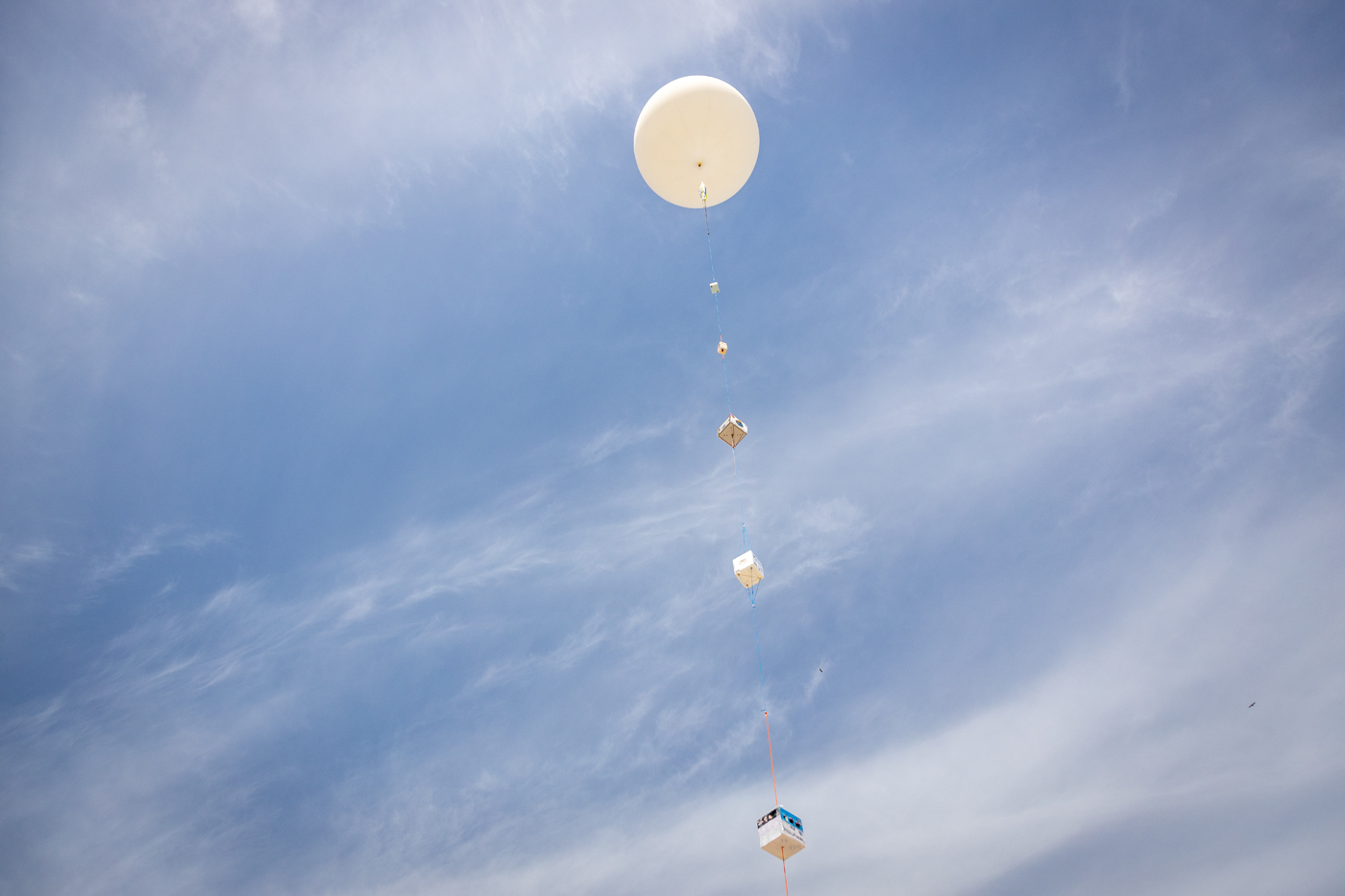
“Mensat 2 – Space Manufacturing” is a project of IES Ramón Menéndez Pidal in Avilés (Asturias), part of the 2nd-year Bachillerato subject “Industrial Technology II”. The students design and build a probe carrying a scientific experiment that is expected to be launched on 15 April 2023.
The aim of our mission is to assess the influence of stratospheric conditions on the possible degradation of 3D-printed parts, for which we draw on the impact resistance tests carried out in industry: two sets of test specimens with standardised designs are made, some of which will stay on the ground during the mission while others
will fly aboard the probe. Afterwards, in the technology workshop classroom, the Charpy pendulum experiment will be reproduced to check the material’s resilience and impact resistance from the energy absorbed by the specimen when struck by a pendulum hammer falling under gravity. The students will build this pendulum themselves in the workshop classroom.
In addition to the mechanical approach, the experiment includes an electronic system to measure the basic physical quantities (pressure, temperature and humidity) throughout the balloon’s ascent and descent by programming a controller board, and it will carry a video camera to record the mission.
- START OF THE PROJECT AND OUTREACH
The Servet VIII mission, in which the technology students take part, besides having an explicit educational application because of the nature of the scientific experiment, is also of great interest to the rest of the school’s students. That is why one of the first tasks was to make the project known.
To do so, since our school was invited to take part in the 1st Science and Innovation Fair of the Principality of Asturias last November, we decided to dedicate our stand entirely to the Servet VIII project.
The students of the 2nd-year Bachillerato Industrial Technology II subject designed a series of posters explaining the project, which were used as decoration. In addition, all the students ran the stand, attending to visitors and explaining the details of the mission.
We also brought the probe sent last year on the Servet VI mission to show the size and look our probe will have this edition. The experience was very positive and aroused the interest of the general public, with ours being one of the most visited stands.
The status of the project is also being updated on our social media, both on the school’s institutional Instagram account @iesramonmenendez and on the dedicated channel @mensat_ies_rmp.
- DESIGN OF THE TEST SPECIMENS AND THE CHARPY PENDULUM
The students have designed the specimens to be used in the mission, which follow the standardised V-notch design typical of this kind of test. For this they used the 3D design program TinkerCAD and printed a series of sample specimens on the department’s 3D printer.
Different specimen lengths have been designed to check which dimensions will be optimal for the experiment, taking into account the volume and weight restrictions for designing the final capsule.
In parallel, several Charpy pendulums have been built using claw hammers, mounted on a gantry-type structure.
The first tests have been carried out in order to check whether the printing parameters are suitable for the test.
The tests have been satisfactory, the longer version of the specimen has been chosen, and the rest of the specimens that will be used in the mission will now be manufactured.
As for the Charpy pendulums, the three versions built by the students have been tested and it has been decided to unify the three models, taking the best of each to build the final impact testing machine.
- OTHER LINES OF WORK
In addition to the mechanical part, we continue to work on other lines, such as:
1) Implementation of the electronic system. An Arduino will be used as the controller board, as the students already have experience with this board. The students are currently practising in the workshop classroom with simple electronic systems, and will then move on to monitoring the physical quantities through the sensors.
2) The LoRa communication system has not been implemented yet, although we have last year’s experience, which we will use as a basis to start implementing it once we finish the previous point.
3) Choice of the container box. The same model as last year will be used, as its behaviour was very satisfactory. However, the students are expected to run free-fall impact resistance tests with a simulated weight, as was also done last year.
4) Choice of the battery. Once points 1 and 2 are finished we will estimate the power consumption to choose the most suitable battery.