
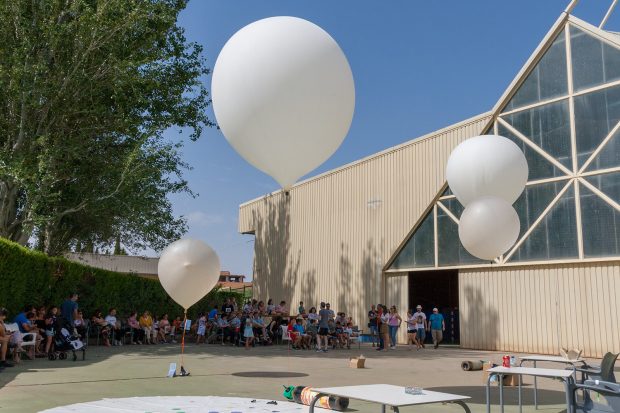
Project title: “Stratosphere Mission: colour and life”
In our project we have designed two experiments, one more related to
Physics and Chemistry and the other to Biology.
EXPERIMENT 1: We start from the question: Why is the sky blue?
We aim to analyse the colour of the sky and study the changes as the
probe rises through the troposphere and the stratosphere.
Design of the experiment
The experimental design includes a Sunstech-4k camera set up to
record images periodically. Photographs will be taken at different heights as
the probe ascends, for later analysis of the colorimetry of the sky.
The camera will be housed in a capsule and, since it will face very low outside
temperatures, one of the difficulties we have met is insulating the capsule well
and making sure its interior does not reach temperatures at which the camera’s battery
stops working. To do this we have studied both the insulation of
the capsule walls and how to keep an internal temperature
above -5 degrees Celsius for the duration of its trip to the stratosphere.
To meet the two goals set, insulation and keeping the
internal temperature of the capsule, we have investigated different possibilities.
As for thermal insulation, we have made several capsule prototypes with
polyurethane foam sheets and a window for the camera lens.
To keep the capsule’s temperature, we have thought of two solutions. One is to
put a heat source inside the capsule, consisting of a battery with a heater
(or resistor), and the other possibility is to put hot water tanks in the capsule
to increase the thermal inertia (the resistance to temperature change). To see the
viability of both solutions, we have decided to run experiments with the different
capsule prototypes, subjecting them to low temperatures in a refrigerator and recording the
evolution of the temperature for at least two hours. With these experiments
we will be able to simulate the effect that the low temperature of the stratosphere will have on the
inside of the capsule. Before carrying out these experiments we made a
thermodynamic study, determining the energy that would need to be supplied to the inside
of the capsule. We will record the drop in temperature over time and
analyse whether the internal conditions of the capsule need to be improved and
adjustments made to achieve our goal.
Plan for analysing the data obtained
The photographs taken will carry a timestamp, which will be cross-referenced with the
probe’s altitude records, so that each image can be assigned an
altitude.
The photos taken will be analysed by looking for the RGB and HSL colour coordinates of
regions corresponding to different angular elevations above the horizon, and
different angular distances from the sun, for each altitude. The software is our own design,
where we have created Octave scripts to analyse the colours of the pixels
by selecting regions of each image.
An image is a matrix of pixels and each pixel has 3 colours: Red, Green, Blue (RGB),
with levels from 0 to 255. The amount of each of the RGB colours changes with
altitude, elevation above the horizon and angular distance from the sun.
With these data we do not intend to build a physical model, but to give a
statistical description of the colour of the sky and how it changes with altitude. These colours are
associated with the different concentrations of gases in the atmosphere and their distribution
in height. The sky is luminous because of the scattering of light, which will change with height.
One of the challenges we have set is to check whether it is possible to see stars in the images
when the probe reaches the highest altitudes (at 30 km the atmospheric mass remaining
above is less than 2%).
If there are clouds, we may get a different effect, but always
below the inversion layer and, in any case, in the troposphere.
Before the experiment with the probe we carried out small-scale field work
taking photos at different altitudes around Granada, from sea level
on the coast at Motril to the highest peaks of the Sierra Nevada, at about 3,400
metres. We already have results from the analysis of the photographs taken
in these preliminary experiments.
Future plan
If our experiment is successful and we can analyse the colour of the sky from the
images taken by our camera, we are considering, in future
calls, putting instruments in the capsule that record indicators allowing
us to measure the parameters needed to answer other
questions: What determines why it looks different colours? Is colour related
to certain atmospheric compounds? Which ones? Is the sky also blue on other
planets?
EXPERIMENT 2: We start from the question: How will bacteria live in the
stratosphere?
Bacteria are part of our lives, for both good and not-so-good reasons.
Among bacteria there are some that are particularly interesting for our lives:
cyanobacteria. These bacteria are responsible for the fact that around
4.3 billion years ago the atmosphere changed into an oxygen-rich one. This
is likely to be replicable on other planets through what is known
as terraforming. Thus, those planets could have an atmosphere similar to Earth’s
with blue skies like ours. It is because of this importance that we wonder
how these bacteria could survive a trip through the stratosphere, taking into account
the low temperatures and changing pressure conditions that occur during the ascent
of the sounding balloon. The students will isolate the cyanobacterium Arthrospira platensis (spirulina)
using differential growth media. The culture will then be placed
in the probe together with a digital thermometer that will record the temperature at every
moment. Once it has made the trip, the culture will be analysed together with a control culture
that stays on the ground, to check how the viability of
the cells studied has been affected. The students will learn basic microbiology techniques and
will learn about the importance these bacteria had in the development of life on
planet Earth.
Both cultures (control and experiment) will undergo viability tests to
check the survival of the cyanobacteria under the conditions. These viability tests
will consist of a colony count of both the test culture and the
control culture. In addition, a vital stain will be carried out using specific
dyes. These dyes can stain cells that have a damaged membrane
(dead cells), while living cells will not be stained by the
dye. The data obtained can be correlated with the temperature and the environmental
conditions recorded.