
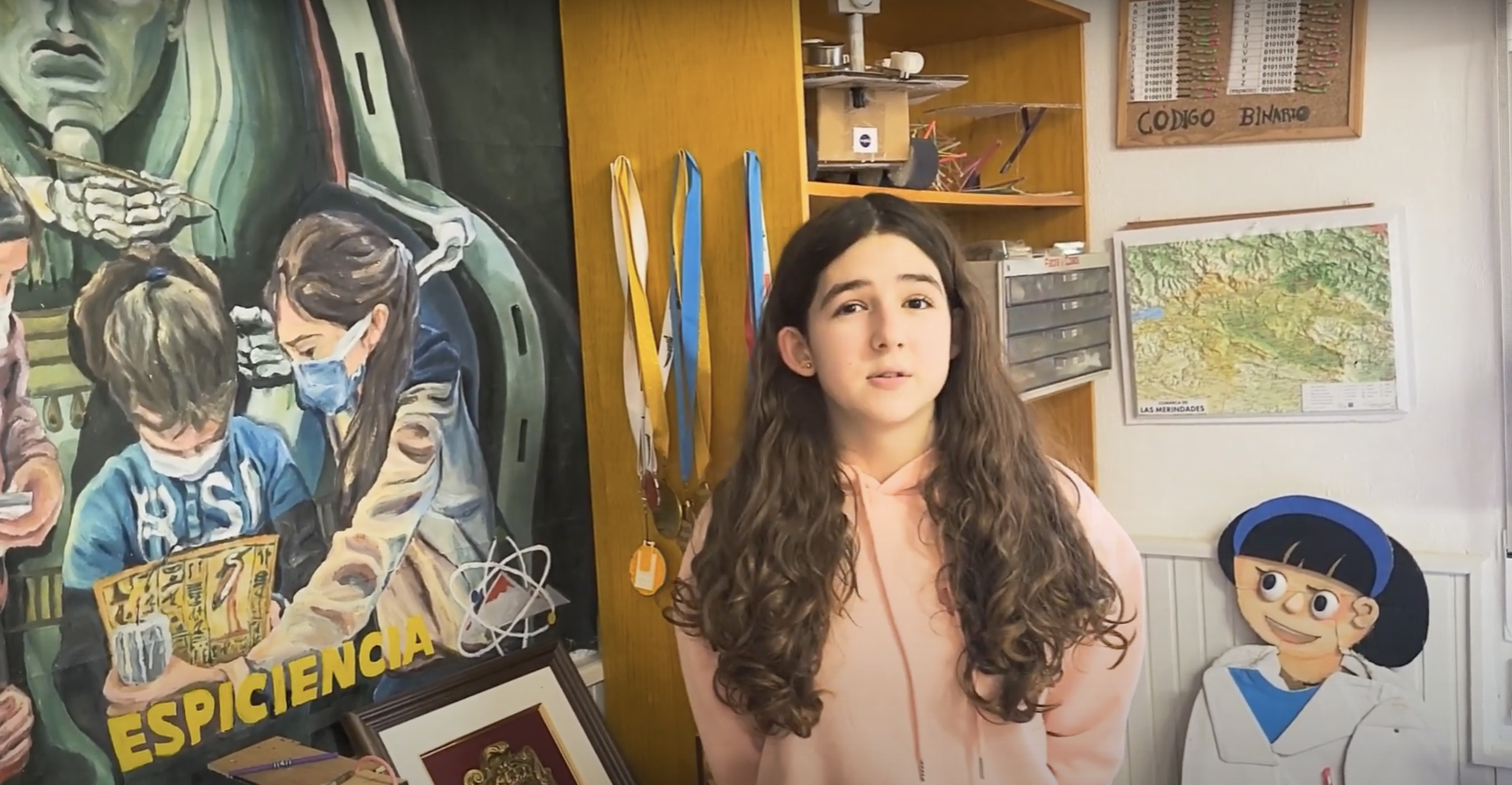
In this video the team from the Espiciencia School of Young Scientists in Espinosa de los Monteros (Burgos) tell us about the progress of their scientific project. The launch will take place in April.
About their experiment: Mars Soil Regeneration
Space exploration and the achievement of permanent settlements in places such as the Moon or Mars will have to solve the problem of producing food such as cereals and vegetables on the surface of these planets.
The soils explored on our satellite and on our neighbouring planet are free of any trace of organic matter and microbiota, so a first phase of any possible use of lunar or Martian soils would need a biological regeneration with the addition of organic compounds such as humic and fulvic acids and of microorganisms able to break them down and colonise the niches they occupy in Earth soils.
The microorganisms and organic substances used in this mission will have to withstand very abrupt temperature changes, as well as high radiation and water stress. This same concept could also be applied to the recovery of soils degraded by fires, contaminated or impoverished (bioremediation).
That is why, at Espiciencia, we have set out to assess the quality of the natural soils of the Merindades (organic matter, soil microbiota, enzymatic activity) before and after sending them to the stratosphere (they will undergo changes in pressure, temperature and radiation during the journey) and to try to restore an inert soil with a composition similar to that of the Moon or Mars using the microbiota resulting from the experiment, checking its health and fertility and its suitability for cultivation.