
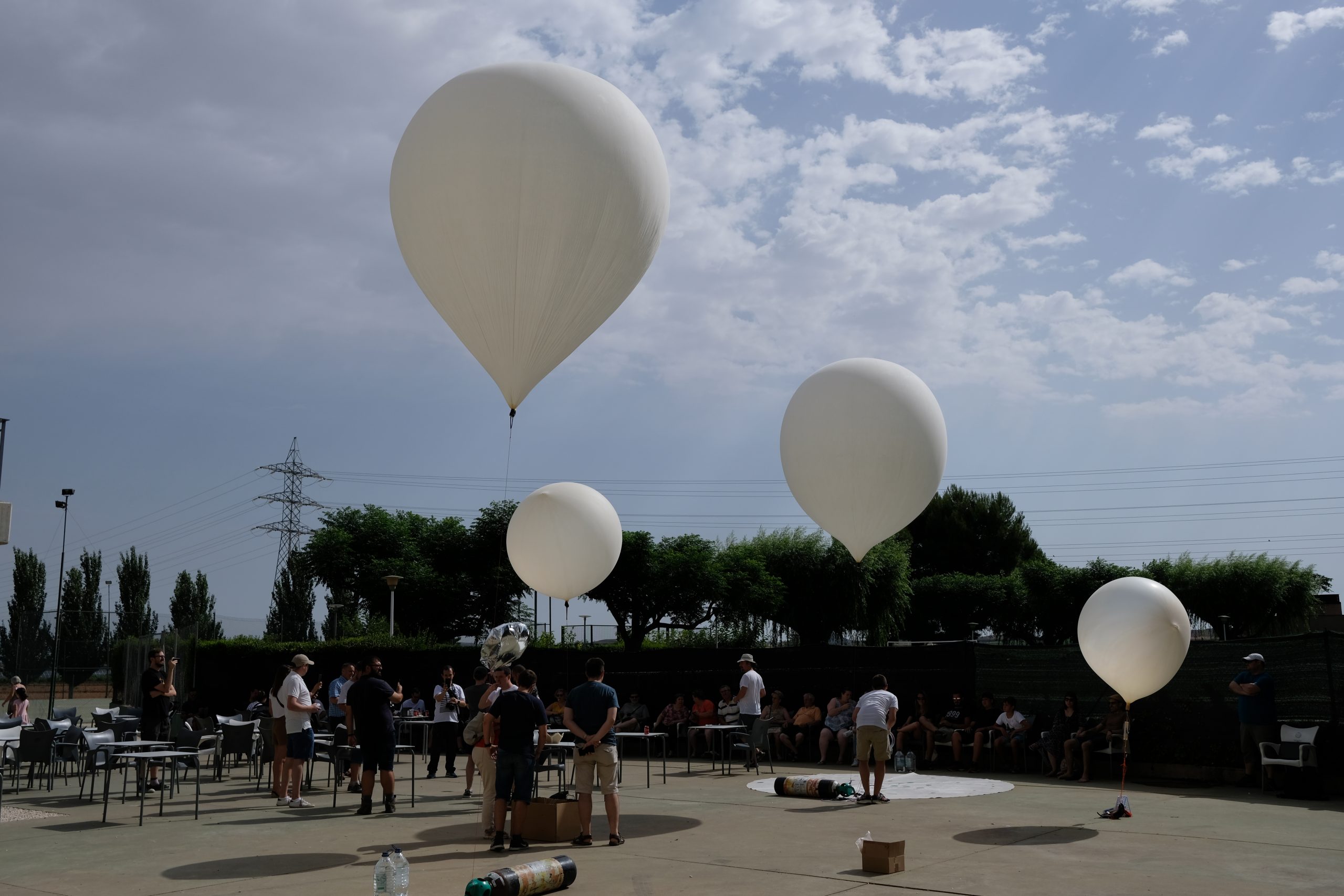
The 14 experiments will be launched in capsules thousands of metres up
The launches are scheduled for next May
Zaragoza, 7 February 2022
SERVET is a citizen science project involving students and teachers from 14 schools across Spain who have been working for several months on their experiments, carried out in the classroom under the supervision of their teachers.
These balloons will reach 35,000 metres in altitude and will collect data for the participating teams, young people in secondary school and Bachillerato, to analyse later in the classroom.
Since they began working on their experiments in mid-November, the groups have been moving forward with the help and support of the project organisers. The first workshop was held on 27 January, and more are planned as the project progresses.
The participating schools have already made progress on their projects:
IES Villafranca (Castellón) will use its experiment to simulate the creation of a cloud in summer, thanks to a balloon that will be attached to the capsule.
IES Benjamín Jarnés (Zaragoza) aims to find the altitude at which a vacuum begins and will have a capsule with three parts, including a fan.
Institut Giola (Barcelona) has hand-made a cream for astronauts; the aim of the experiment is to take it up to the stratosphere to analyse the changes it undergoes.
Espiciencia (Burgos) have considered the importance of knowing how microorganisms are distributed through the air, at different heights, under difficult conditions.
Liceo Molière (Zaragoza) is going to launch lentils to the stratosphere and will compare them with a material that processors carry: quartz. The curvature of the Earth will also be studied, and there will be cameras to analyse the shape of clouds, as well as to measure ozone.
Escola Virolai (Barcelona) uses cameras and filters to analyse images, taking photos that will report on the health of plants.
IES Peñamayor in Nava (Asturias) will take cider to the stratosphere; the typical Asturian drink will be analysed before and after the launch. “The activity is set up as closely as possible to how a project would be run in an engineering company,” one of the teachers tells us.
IES Kursaal (Cádiz) will use micrometeorite samples that will change the texture of the cotton included in the capsule depending on altitude. This project is based on building a scientific station able to take certain measurements of the air during the ascent and/or descent to the stratosphere and to store or transmit that data, for which we will use a sounding balloon.
IES Villa de Firga (Las Palmas) will film with a camera for one hour. The aim will be to measure luminosity, pressure, temperature and humidity.
The team of students from CPI Poeta Uxío Novoneyra, Folgoso do Courel (Lugo) want to measure temperature, pressure and ozone concentration, and will also have cameras to measure the curvature of the Earth.
Colegio Nuryana, in San Cristóbal de La Laguna (Santa Cruz de Tenerife) will present the scientific project “Resistance of Artemia salina cysts exposed to stratospheric conditions”. The team has designed an Artemia hatchery using household materials.
IES Ramón Menéndez Pidal in Avilés (Asturias) is actively working on its project, which consists of measuring the performance of solar panels in the upper layers of the atmosphere. Progress so far: outreach campaign, purchase of materials and implementation of the project.
Colegio Teresiano del Pilar (Zaragoza) has run several tests to check the approximate total weight of the capsule and how it will fare once anchored, and is considering using a camera that records in 360 degrees. They are going to analyse bacteria that they will collect from different places around their school.
Colegio Juan de Lanuza (Zaragoza) has assigned different tasks to each student. “We are now at the stage where we are starting to put sensors together on a single Arduino and merge the code,” one of the teachers says. They have also recorded a video telling us about their progress.
The capsule launches are scheduled for May; the participating teams will travel to Zaragoza to carry out the launches and meet the other participants in the citizen science project.
Servet has the support of the Ibercivis Foundation, Etopia Centre for Art and Technology, the CESAR Laboratories at Etopia, the University of Zaragoza and the Spanish Radio Amateurs Union, and is funded by the Spanish Foundation for Science and Technology – Ministry of Science and Innovation.