
The citizen science project adds another success with the launch of two helium balloons carrying experiments by citizen scientists
They took off from Mallén (Zaragoza) at almost 12 noon and took 1 hour and 30 minutes to touch down near Barbastro (Huesca)
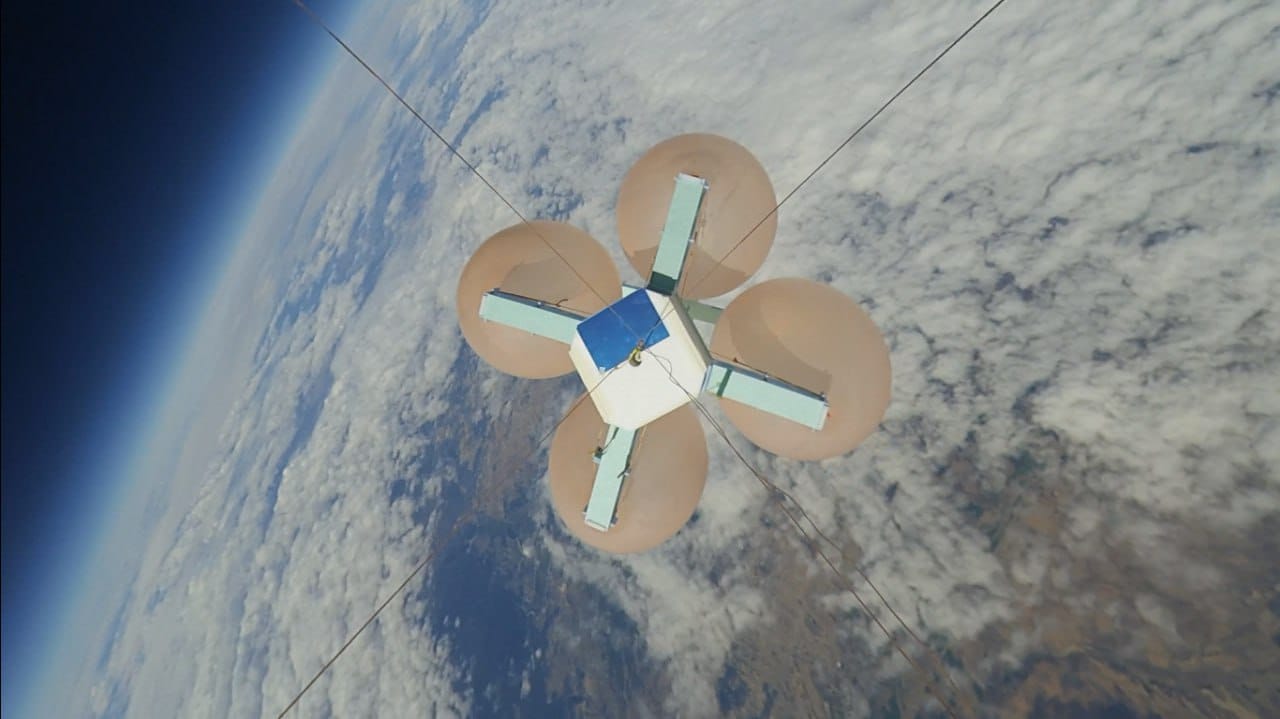
This Saturday, the Servet citizen science project had another success with the launch of two helium balloons that carried more than 20 capsules. Both balloons rose above 30,000 metres in altitude and travelled more than 100 kilometres each.
The first balloon was launched at 11:47 from Mallén and reached a maximum altitude of 31,500 metres. It took 1 hour and 45 minutes to cover the 115 km separating it from the town of Berbegal, in Huesca. The second was launched ten minutes later, at 11:57, covering 101 km from Mallén to the town of Sesa (Huesca). The maximum altitude the balloon reached was 30,500 metres.

The scheduled launch time was 11 in the morning, but because of a plane taking off from Zaragoza it had to be delayed a few minutes until permission was received from the Zaragoza air traffic control centre. During the launch preparations, many people from Mallén and nearby towns, including many children and young people, came to the municipal sports hall to see up close how the citizen scientists of the Servet team work.
In total, there were fourteen capsules designed and built by the citizen scientists themselves. Their design took into account the extreme conditions they would face: winds of more than 200 km/h, -60ºC and a landing at about 6 m/s. The experiments in this edition are very varied: long-distance communication experiments, radiolocation, collection of atmospheric data and particles, satellite prototyping, and agriculture-related studies such as the effect of these extreme conditions on wheat or the acidity of olive oil. A tracking system made it easier to locate the capsules after landing, which will allow the collected data to be analysed.
The Servet team collected the capsules in some fields near the Guatizalema river; those of the second balloon were caught in a tree and they had to climb it to rescue them. After the launches, the participants met at Etopia to share experiences and the preliminary data collected by the capsules. Now the data and samples obtained have to be analysed, the seeds germinated and conclusions drawn.
Servet is a citizen science project to democratise access to space, involving a whole community of enthusiasts of astronautics, space navigation and anything that moves above 12,000 metres above sea level. Servet is run by the University of Zaragoza through the Aragon Engineering Research Institute (I3A) and the Ibercivis Foundation. It also has the support of Etopia Centre for Art and Technology and the CESAR Laboratories at Etopia, and is co-funded by the Spanish Foundation for Science and Technology – Ministry of Science and Innovation. We thank Mallén Town Council and the Zaragoza air traffic control centre for their collaboration.