
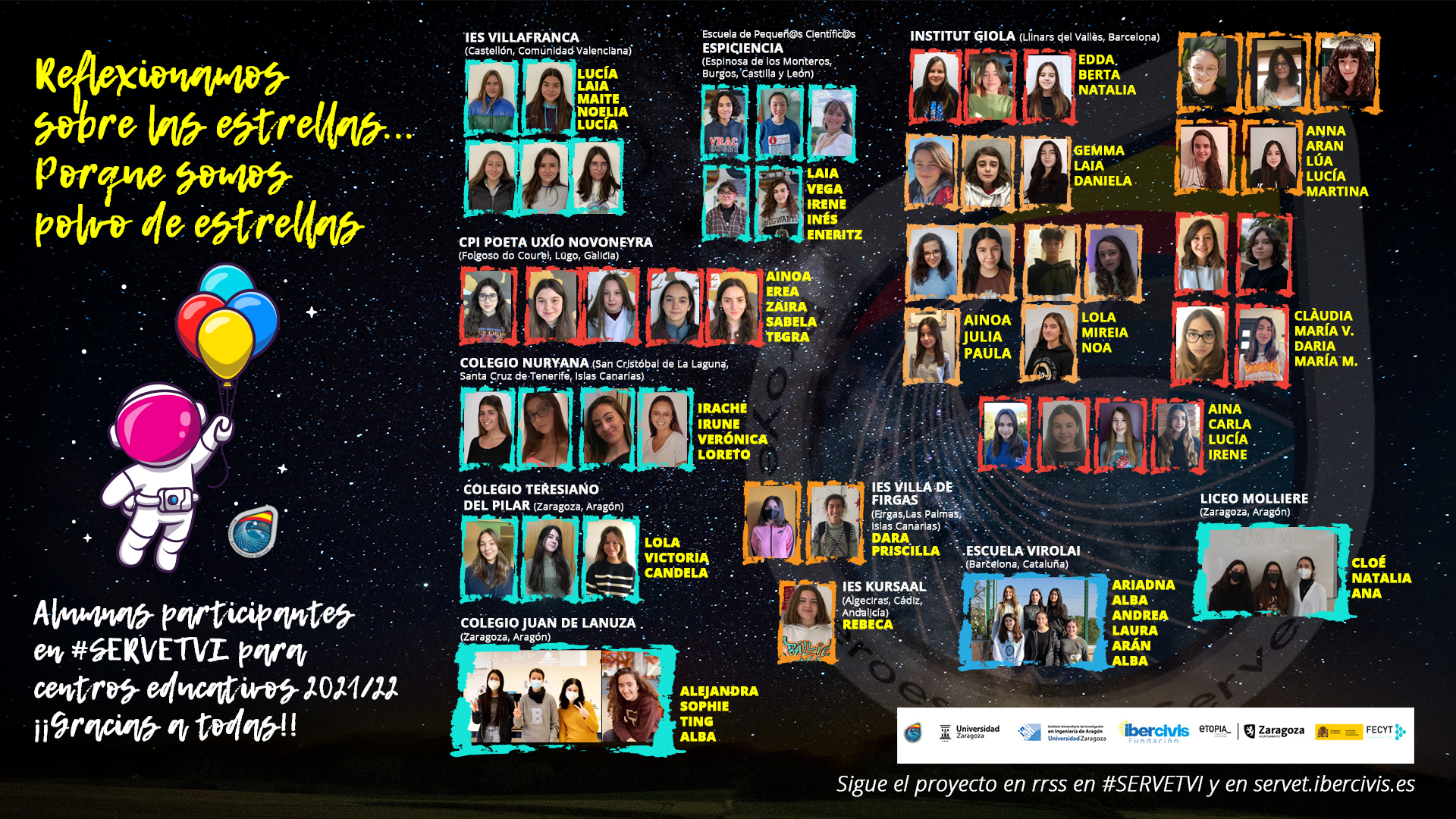
More than 60 young people from 14 schools across Spain take part in the citizen science project
At Ibercivis we show our commitment to education in equality
Servet has reached its sixth edition stronger than ever: 14 schools across Spain are working hard to prepare their experiments, which will be launched into space next May, weather permitting. And many of those taking part are secondary school students who, thanks to #ServetVI, will be able to learn about and create experiments, bringing science closer to the youngest students. It is precisely at this stage of the educational process that it is most necessary to bring science closer to girls and make visible all their potential, which will be developed later on.
Ibercivis wanted to join the International Day of Women and Girls in Science, commemorated this 11 February, by showing the role that teenage girls play in this kind of science and research project. We want to make visible the importance that this kind of citizen science project has in promoting a fair and full education for women in science.
Even so, women still face obstacles in more technical and scientific careers, so it is necessary to commemorate this day to empower women, make visible the work they do in all disciplines and highlight their contribution. In addition, this day also serves to call for improvements in working conditions and in women’s access to scientific careers.
The United Nations puts the spotlight on some figures that show why, even today, a day has to be commemorated to value women’s strength in science. They are the following:
- Access to grants: Women receive more modest research grants than their male colleagues
- Positions of power: Women make up 33.3% of all researchers but only 12% of the members of national science academies are women
- Innovation: In one of the most modern areas of innovation, artificial intelligence, only one in five is a woman
- Gap in engineering and computing: Women make up 28% of graduates in engineering degrees and 40% in computer science
- Academic publications: Their work also lacks the representation it should have in academic publications, given the role they play in science
Thank you all for doing #citizenscience!

More than 60 girls take part in ServetVI. Image: Daniel Lisbona (Ibercivis)
Since when has #11F been commemorated?
The General Assembly declared 11 February the International Day of Women and Girls in Science in recognition of the key role women play in the scientific community and in technology. In its resolution of 22 December 2015, the United Nations body in which all Member States are represented adopted a resolution justifying the proclamation of this International Day
Days like this serve to raise awareness of different causes and to put the focus on issues that are not usually at the centre of media attention.
FECYT: The presence of women in Spanish science
The Spanish Foundation for Science and Technology has carried out a study to analyse the role women play in the production of science in Spain: “The presence of women in Spanish scientific output”. 304,165 documents were analysed, identifying 145,276 researchers from Spanish scientific institutions.
In 48% of Spanish scientific output there is a woman among the signatories of the publication, but only 20% of women researchers lead publications. The average of Spanish scientific output in international collaboration stands at 53%, a figure that falls to 48% in output in which women researchers take part, although this figure has been rising year after year.
The subject categories with the largest number of documents in scientific output with women’s participation are Environmental Sciences; Materials Science; Biochemistry and Molecular Biology; Food Science; Physics-Chemistry; Chemistry; Pharmacology and Pharmacy; and Neurosciences. The areas with the lowest presence of women are Engineering and Mathematics.