
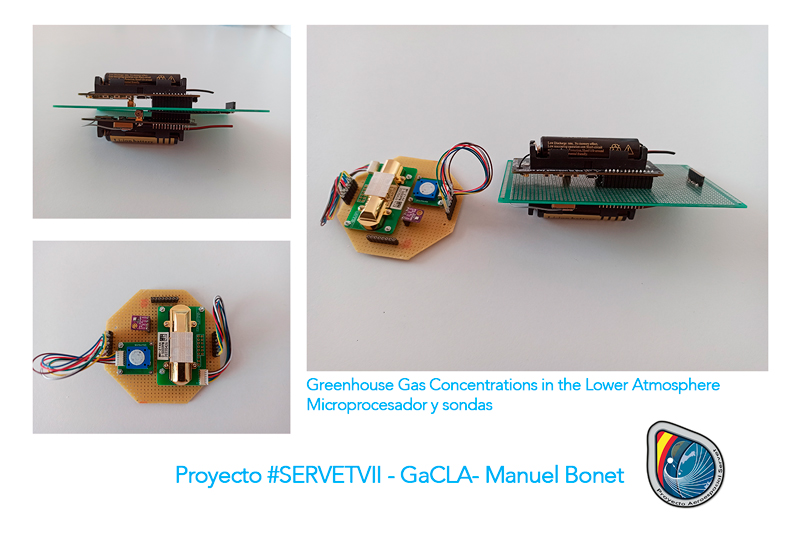
We present each of the citizen science experiments that will be taken to the stratosphere in the #SERVETVII launches, in autumn 2022. GaCLA (Greenhouse Gas Concentrations in the Lower Atmosphere) is a project by Manuel Bonet.
The atmosphere is made up of a diverse group of gases. Some of them, such as carbon dioxide, water vapour or ozone, convert infrared rays into heat especially efficiently, thus influencing the temperature of our planet. It is because of this phenomenon that they are known as greenhouse gases.
Something worth highlighting about these gases is that their concentration varies with the altitude at which the measurement is taken. In the first few kilometres, their concentrations are higher because of anthropogenic effects, that is, those produced by human beings. Examples are the burning of organic matter (such as fossil fuels or vegetation) or the results of industrial processes. Further up, between roughly 15 km and 50 km in altitude, an especially high level of ozone is observed, produced by the interaction between ultraviolet rays from space and atmospheric oxygen. This band of the atmosphere is known as the ozone layer, responsible for reducing the high-energy ultraviolet radiation that reaches the Earth’s surface.
The purpose of this probe is to find out how the concentration of these gases (water vapour, carbon dioxide and ozone) varies with altitude. In this way, the magnitude of anthropogenic effects in the lower atmosphere and the ozone concentration in the first half of the ozone layer can be roughly determined.
If you want to know about all the citizen experiments and probes that will be launched in #SERVETVII, visit the selected proposals area.