
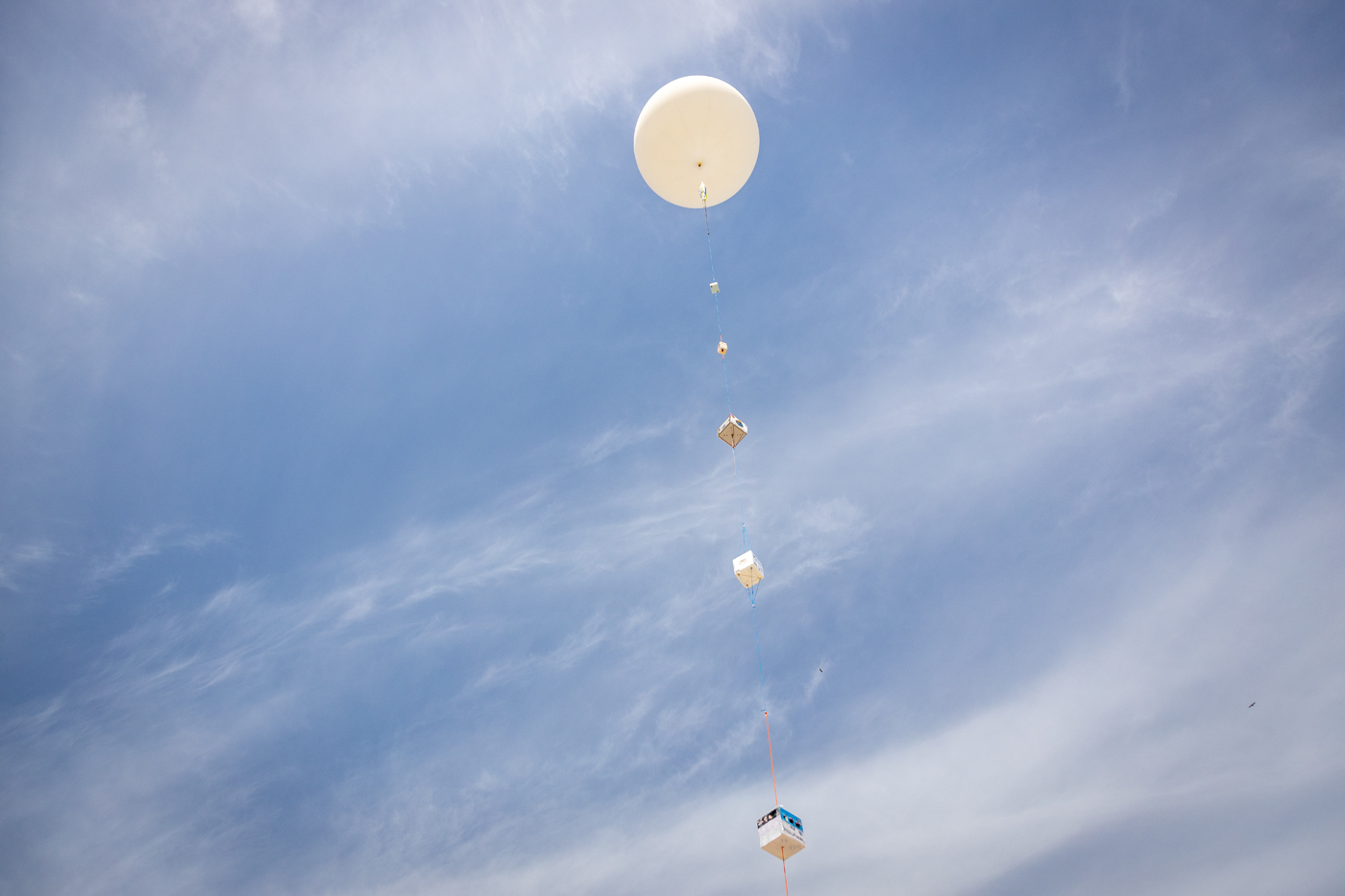
Our project aims to verify whether there is a layer in the atmosphere similar to the underwater SOFAR channel, in which infrasound travels long distances without significant attenuation. This is because, owing to the conditions of salinity, temperature and pressure, that layer behaves like a waveguide.
To verify whether an atmospheric SOFAR layer exists, two experiments are proposed:
- Experiment no. 1: measuring the speed of propagation of sound in air. In the underwater SOFAR channel the speed decreases down to a depth of 700 metres, where it increases again. The idea is to take measurements at different heights to check how the speed of sound evolves and whether we find a minimum at heights
close to the tropopause, where some studies suggest that a propagation phenomenon similar to the underwater SOFAR channel may occur. - Experiment no. 2: recording infrasound coming from distant sources. At heights close to a hypothetical atmospheric SOFAR layer, the sources of infrasound we aim to listen to are aircraft.
- In addition, there will be a third experiment in which the anthem of our region (“Asturias, Patria Querida”) will be played in the stratosphere to check whether there are variations in the qualities of the sound.
- START OF THE PROJECT AND OUTREACH
Not all the students taking part in the project have programming skills or experience with controller boards, so it was necessary to start with a grounding in the fundamentals of programming and a review of basic concepts of electricity and electronics.
The members of the group also take on different roles, split into different “departments”. The aim is for them to have a working experience as close as possible to what they would have in a technology company. So a purchasing department, an IT department and a marketing department are set up, and the person in charge of each is appointed.
In parallel, the project is promoted to the whole educational community through various
actions:
1) Information boards about the project were set up at the school.
2) The project was shown at the 1st Science and Innovation Fair of the Principality of Asturias, held at Laboral Centro de Arte on 17/11/2022.
3) RTPA (the Asturian regional television) made a report at our school on 01/12/2022, which was broadcast in the midday news.
4) On the Instagram account of the school’s technology department (@robot.nava), information on the project status is updated regularly.
- SEARCH FOR SPONSORS AND PURCHASE OF COMPONENTS
To pay for the components, sponsors have been sought. So far, we have secured the collaboration of the town councils of Nava, Cabranes and Bimenes, the 3 localities our school’s students come from.
To purchase the components, the students in the purchasing department have researched online to choose those best suited to the working conditions they will face during the mission.
- MEASURING THE SPEED OF SOUND
During the mission, we will measure the speed of sound propagation to see whether there are variations during the ascent or
descent similar to those that occur in the underwater SOFAR channel (see figure).
Since on our planet the speed of propagation does not depend on frequency, we decided not to measure the speed of infrasound directly but that of ultrasound, as there are inexpensive Arduino-compatible sensors that allow this measurement.
In the technology workshop we have set up an experiment to check the viability of the components.
The first test we ran is of the viability of the sensor itself (HC-SR04). For this, a first program is written that measures the distance to an obstacle. The measurement is made by timing the propagation of a pulse, using a speed of sound of 340 m/s. The measurement obtained is compared with the real one.
Distances from 5 mm to 200 mm are tested and it is observed that for large distances the error is practically zero, but for distances below 50 mm the error is significant. We will keep testing, as the space available inside the container will be limited.
Knowing these limitations, we moved on to the inverse experiment: starting from a known distance and measuring the propagation time, calculate the speed of sound and compare it with the real value. To obtain a more precise value, a temperature sensor has been included, taking into account that, relative to the theoretical value, the speed of propagation increases with temperature at a rate of 0.6 m/s·ºC. With this, valid results are obtained with small margins of error.
- NEXT STEPS
The next steps we are working on are the following:
- Evaluation of the ultrasound sensor at distances below 50 mm, considering
factors such as the material the obstacle is made of, its inclination or the opening cone
of the sensor. - Tests at temperatures other than room temperature.
- Decision on how to listen to the infrasound. Two options are being considered: recording
with a microphone or using the RedVox app by installing a reused smartphone
aboard the probe. The first option is more expensive, but implies less weight. The second is
cheaper and more interesting because we can record data in the frequency
domain, but it will increase the weight of our probe. - Design of the system for playing and recording the anthem of Asturias.
- Programming of data recording to memory in a CSV file for later analysis.
- Programming of LoRa telemetry.
- Evaluation of the container. We initially plan to use the same container as
last year, although we must assess whether it offers the volume we need to work with. - Evaluation of the battery. We will initially draw on last year’s experience and
reuse the same battery.