
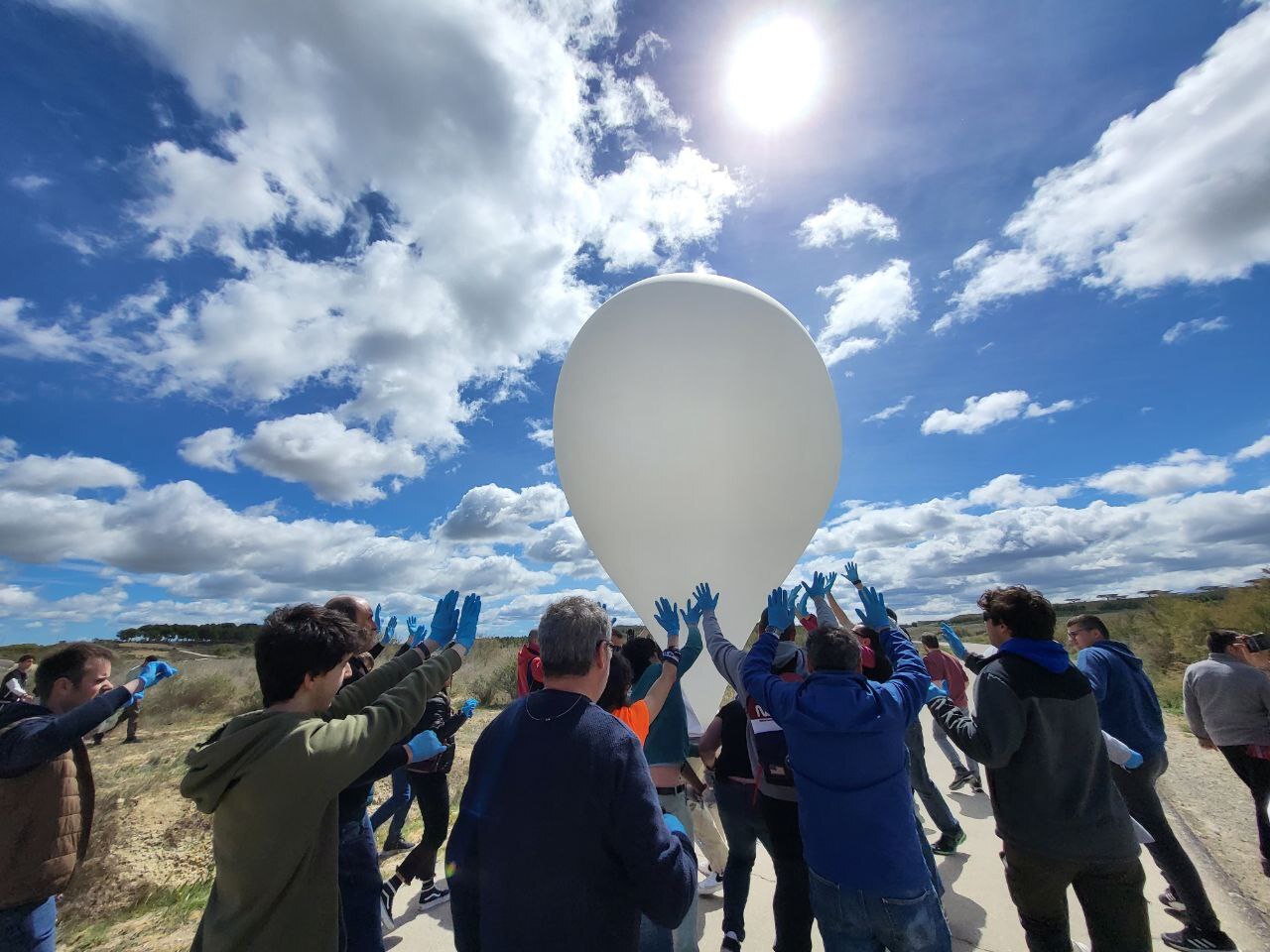
The eighth edition of the Servet citizen science project launched, this weekend, a balloon carrying 14 experiments made by students from all over the country from the town of Ejea de los Caballeros, in Zaragoza. The strong wind made the launch very difficult, to the point that a first failed launch raised serious doubts about the viability of the mission. In the end, the organisation decided to try a second launch with all the experiments, which was a complete success thanks to the collaboration of the participants themselves. Amid applause and cries of joy, the balloon rose to the stratosphere loaded with the fourteen citizen science experiments.
The balloon set off from Ejea de los Caballeros and landed, after two hours of flight, in Valdealgorfa, near Alcañiz, reaching an altitude of 28,846 metres. A team travelled to the landing point and recovered all the capsules, which were handed over to each of the teams, starting the process of analysing the data obtained. The wide range of experiments carried out in the stratosphere includes the study of seed germination and of the quality of wine after being affected by extreme conditions of ultraviolet radiation, low pressure and low temperature; the presence of phenols derived from plant protection products and of small particles – PM10, PM2.5 – in various layers of the atmosphere; the transmission of low-frequency sounds in those same layers; and the measurement of the atmospheric turbulence coefficient, which is used to gauge the viability of laser-based communications in the atmosphere. Photographs and videos were also taken from the stratosphere.
More than 200 people attended the event, including students and teachers from the 14 participating schools, the project team and members of the public, who were able to see the project up close and watch the launches.


The launches were also attended by the President of the Government of Aragon, Javier Lambán, accompanied by the mayor of Ejea de los Caballeros, Teresa Ladrero, and the Commissioner for the 2030 Agenda of the Government of Aragon, Fermín Serrano. The mayor of Nava (Asturias), Juan Cañal, was also present, who came to the event with the students of IES Peñamayor, a participant in the project.

A project to foster innovation and creativity among young people
In the days before and after the launch, Etopia Centre for Art and Technology became the project’s operations centre. On Friday the teams finalised their scientific missions and on Sunday a preliminary presentation of the analysis of the data obtained took place. The citizen science project fosters innovation and creativity among young students, and also promotes collaboration and the exchange of knowledge among the participating schools, creating an enriching learning environment among schools from all over Spain, with schools from Andalusia, Aragon, Asturias, the Canary Islands, Castile and León, Catalonia, the Valencian Community and La Rioja.
Servet is organised by the Ibercivis Foundation, the University of Zaragoza through the Aragon Engineering Research Institute (I3A), Etopia Centre for Art and Technology of Zaragoza City Council and the CESAR Laboratories at Etopia; it has the support of the Spanish Radio Amateurs Union and Ejea de los Caballeros Town Council, and is funded by the Spanish Foundation for Science and Technology – Ministry of Science and Innovation.