
Tensile and penetration tests on fabrics
Introduction
The aim of this research is to determine whether stratospheric conditions can affect the properties of the fabrics that were sent there.
During the balloon launch the climb lasted 1 h 15 min and the descent about 45 min, a period with conditions different from the normal ones at ground level. During the process the fabrics reached an altitude of 33,000 m above sea level.
Some sensors that measured UV radiation were covered with fabric samples. The one without any cover recorded a constant radiation of 3,300 units of measurement (hereafter: udmUV), the sensor covered with the UV protection fabric (UV UPF50+) stays constant at 300 udmUV and finally the cotton fabric shows a large dispersion between 1,500 and 3,000 udmUV. However, this data is only stored up to 11,000 m, where the system fails. It would have been interesting to see the information from 15,000 m, where the ozone layer is, where UV radiation would have taken much higher values.
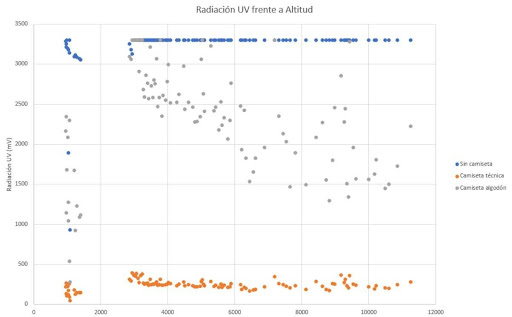
(Graph with readings taken during the test)
Penetration test
Test design
For this test we are going to drop a sharp object onto a fabric with some weight. Specifically a screwdriver with added weight, dropped from different heights above the specimen. The specimen will be placed on a cardboard box taped to the lid.
Specimens
For this penetration test we designed a square specimen because it is very easy to obtain and gives a large area in which to carry out the experiment. The specimens measure 50 mm x 50 mm, giving an area of 2,500 square millimetres. To standardise the specimens we created a design in SketchUp and a template, which allowed us to trace the shape of the specimens that were then cut out.
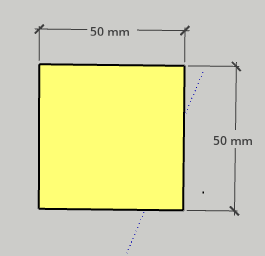
(Design of the specimen for the penetration test made with SketchUp)
Experimentation
To standardise the heights and weights needed, we kept dropping the screwdriver until we found a height at which it penetrated the fabric between 2 cm and 10 m. If the penetration was too small or too large, the measurement was difficult, so to find the ideal penetration the weights were varied. Since the initial free-fall height was too high, and dropping the screwdriver in the exact position it should land was very complicated, the height was reduced and the weight increased, leaving useful measurements. Once the process was standardised, it could be repeated indefinitely under the same conditions. Finally, for the tests on the microfibre fabric and the UV protection fabric, a screwdriver with 400 g added will be dropped from a height of 12.5 cm, and the cotton fabric, with only 100 g (in addition to the weight of the screwdriver), will be dropped from 41.0 cm.
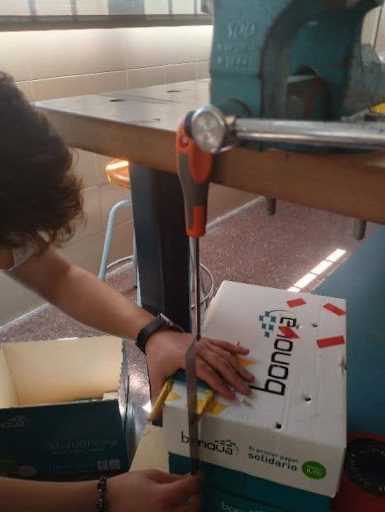
(Image of the penetration test)
Results and conclusions
The tests on both fabrics show almost identical results, except perhaps for the cotton, where there is greater penetration in the sample that went to the stratosphere. In any case, this data could indicate that the test is not conclusive because of the way the penetration of the fabrics is measured. The difficulty in measuring that penetration may be due to the way the screwdriver hits the fabrics, since once the tip has penetrated, the only force slowing it down is friction, which can easily vary according to the angle of penetration. This angle depends on the dropping technique, since the screwdriver is dropped from a bar, which makes it difficult to obtain great precision.
| Servet test results | ||||||
| Type of test | Type of specimen | Microfibre | Cotton | UV UPF50+ | ||
| Penetration | Height | 12.5 cm | 41.0 cm | 12.5 cm | ||
| Weight | 400g | 100g | 400g | |||
| Stratosphere | 45mm | 40mm | 20mm | |||
| Test 1 | 45mm | 25mm | 20mm | |||
| Test 2 | 40mm | 30mm | ||||
| Key | Tests made with material from the stratosphere | |||||
| Tests made with material under ground-level conditions | ||||||
Tensile test
Test design
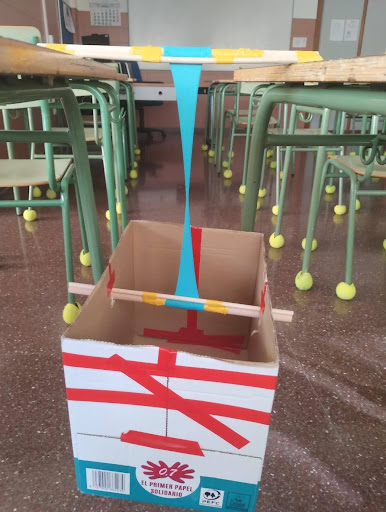
To hold the specimen so that it does not break at that point, we chose to wind it around two wooden cylinders. This allows it to be tightened more, preventing slipping and making it harder for it to break in that area, which would invalidate the test. The specimen is rectangular with a circular narrowing in the centre and with two cuts of different sizes depending on the fabric, in order to obtain a greater narrowing. This narrowing forces the specimen to break in the narrowest zone, using the circular shape so that there is no critical point where it could break and invalidate the test. The lower structure where the weights are placed consists of a box into which two sticks are fitted to hook it, and the upper structure has to be stuck at both ends to a table so that a gap is left in the middle for the box to hang.
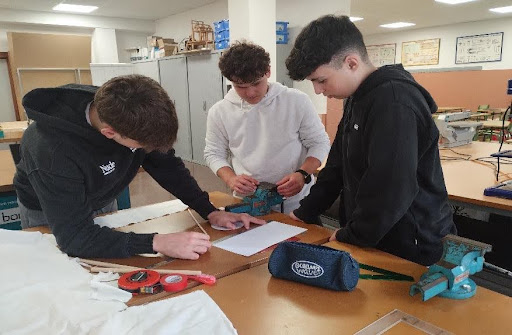
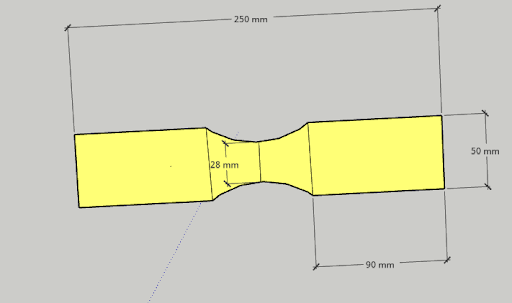
(Image of the design of the specimens for the tensile test)
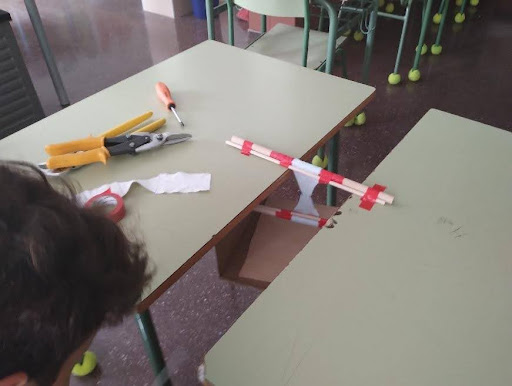
Specimens
The base specimen for the tensile test is the same for all the fabrics. It is 250 mm high and 50 mm wide. The narrowing was made with a CD, which has a radius of 120 mm. In addition, we are going to make a cut in the middle of the narrowing depending on whether it is the UV UPF50+ fabric, microfibre or cotton, with sizes of 1, 0.5 and 0 cm respectively.
Experimentation
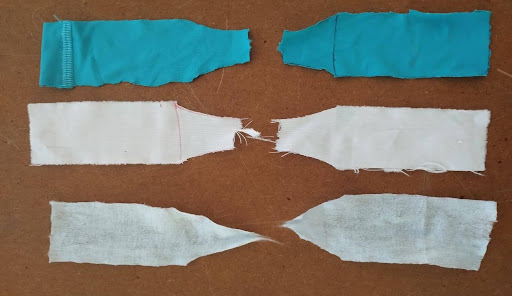
The first fabric we tested was the cotton one. At that point we did not have the weights yet, so we did not know exactly how much it had withstood. Then, testing the other fabrics, we came to the conclusion that the one that withstands the most is the UV UPF50+ fabric because of its elasticity, then the microfibre and lastly the cotton. This is why we decided to make the cuts mentioned above, so that we would not need to hang too many weights. When we had the weights, we experimented with all the fabrics to see how they behaved and whether the structure we had built for the test worked well. After many tests we realised that the microfibre fabric has a cutting direction that withstood more than the other, and we did not know which direction the specimen we sent was, but otherwise the experiments went well.
Conclusions
After carrying out the tests on the specimens we sent and comparing them with those we made here, we came to the conclusion that in general there are no noticeable differences between the two. Except for the microfibre fabric, where, depending on the direction of the fibres, a considerable difference in the weight it withstands can be noticed. At first we thought this was due to exposure to radiation, but after doing more tests we concluded that it was not.
| Servet test results | |||||||
| Type of test | Type of specimen | Microfibre | Cotton | UV UPF50+ | |||
| Tensile | Notch (cm) | 0,3 | 0 | 1 | |||
| Stratosphere | 2500g | 2100g | 3250g | ||||
| Test 1 | 1700g | 2500g | 3565g | ||||
| Test 2 | 3310g | 2015g | |||||
| Key | Tests made with material from the stratosphere | ||||||
| Tests made with material under ground-level conditions | |||||||
Organisation of tasks
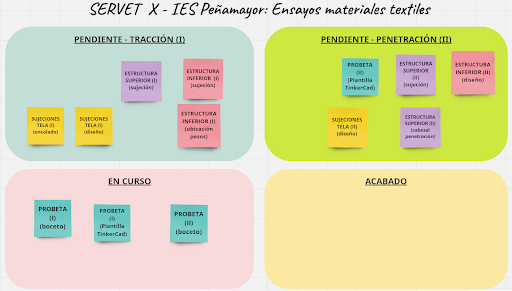
To know which tasks we had to do and which were already done, we used an online Kanban board. With this software the main tasks were created and then, if a new task appeared, it was added to the others. As tasks progressed, they were moved to the “Completed tasks” section:
Session 2
Session 8
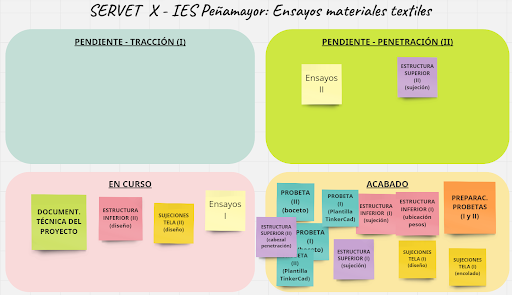
(Image of the Kanban board made with miro.com)
Session 12
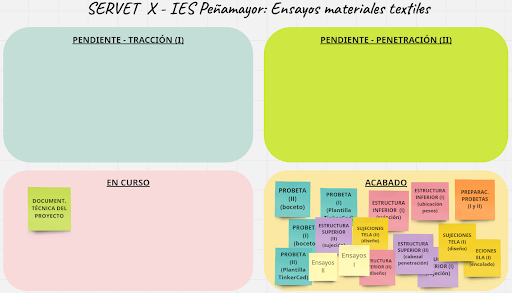
(Image of the Kanban board made with miro.com)
This way we have been able to share the work more efficiently and we always knew which tasks were in progress, finished or still to start.